
Stress & Coping
Five Ways to Manage Stress in the Moment
Practical strategies for slowing down, getting grounded, and responding to stress more intentionally.
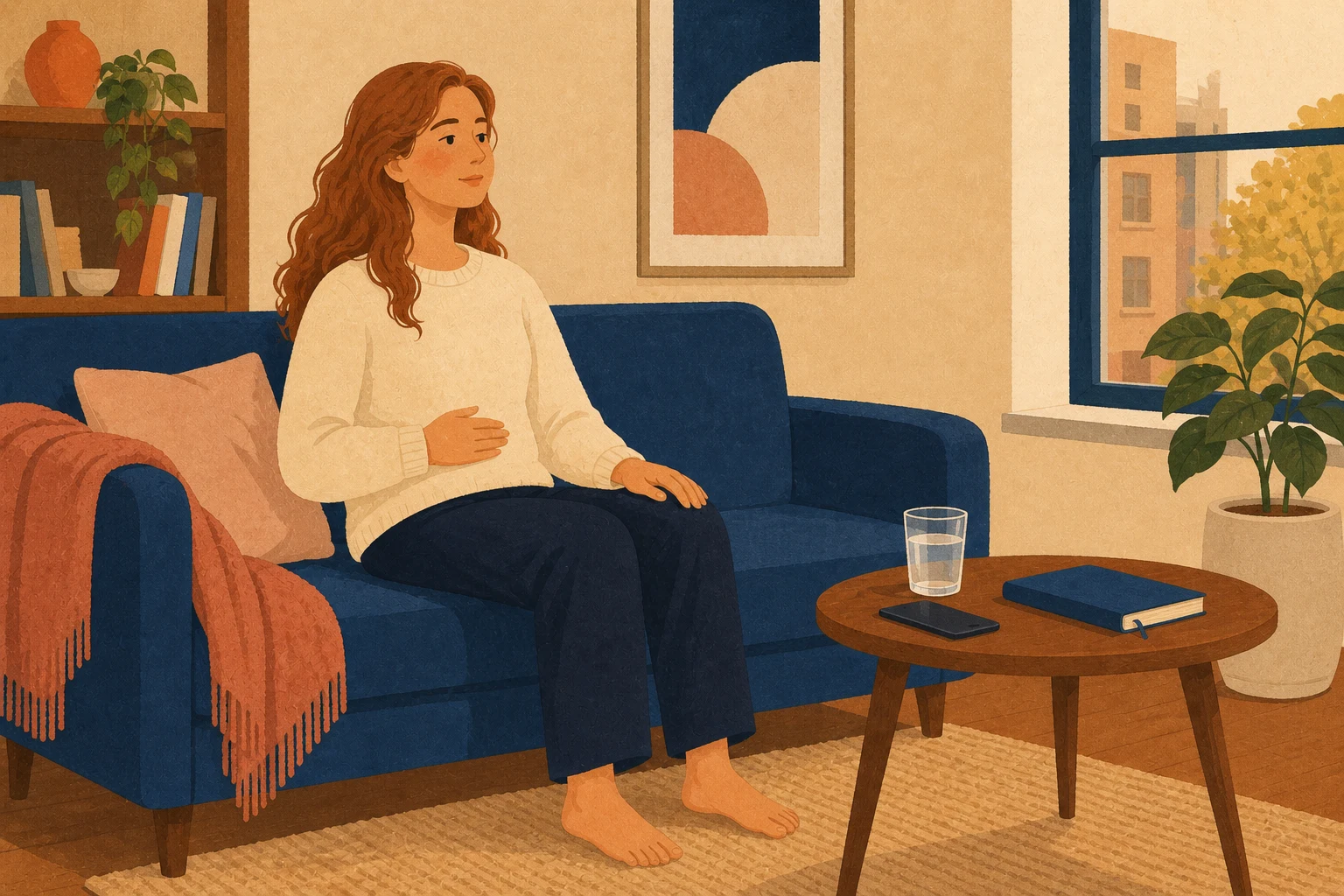
Stress is a normal part of life. A difficult conversation, an overwhelming to-do list, a work deadline, an unexpected change, or simply having too many demands at once can leave your mind racing and your body feeling tense.
We cannot eliminate every stressful situation. We can, however, learn ways to respond when stress begins to build.
Stress management is not necessarily about making yourself feel completely calm. Sometimes the more realistic goal is to bring the intensity down enough that you can think more clearly, reconnect with the present moment, and decide what you want to do next.
The following strategies are simple tools that can be used when stress shows up in the middle of everyday life.
1. Slow Down Your Breathing
When we become stressed, our breathing can change without us consciously noticing it. We may breathe faster, take shallower breaths, hold our breath, or feel as though we cannot quite get a satisfying breath.
Intentionally slowing your breathing is one way to work with the body’s physiological response to stress.
Research on regulated and slow-paced breathing suggests that breathing exercises can influence physiological measures associated with arousal, including heart rate and heart-rate variability, and may also help reduce subjective stress and anxiety for some people (Bentley et al., 2023; Shao et al., 2024).
You do not need a complicated breathing pattern.
Try this:
- Breathe in gently through your nose.
- Allow the breath to move comfortably into your abdomen rather than forcing an especially large breath.
- Exhale slowly.
- Let your next breath come naturally.
- Continue for a minute or two, gradually allowing your breathing to become slower and more comfortable.
Some people like counting, such as breathing in for four counts and breathing out for six. Others find counting distracting.
There is no prize for having the most impressive breathing technique.
The goal is simply to slow things down.
If deliberate breathing makes you dizzy, uncomfortable, or more anxious, return to your normal breathing pattern and try another grounding strategy instead.
2. Bring Your Attention Back to the Present
Stress often pulls our attention away from what is happening right now.
We replay what already happened.
Why did I say that?
Or we race ahead to what might happen.
What if this goes badly? What if I can’t handle it? What am I going to do?
Mindfulness involves intentionally bringing attention to present-moment experience rather than automatically following every thought that appears. A meta-analysis of mindfulness-based stress reduction for healthy adults found meaningful reductions in stress and related symptoms, while also noting variation among the included studies (Khoury et al., 2015).
You do not have to meditate for thirty minutes to begin practicing present-moment awareness.
One simple option is sensory grounding.
Look around and notice:
- Five things you can see.
- Four things you can physically feel.
- Three things you can hear.
- Two things you can smell.
- One thing you can taste or notice in your mouth.
The exact 5-4-3-2-1 exercise has not been researched as extensively as mindfulness interventions more broadly, so it is better understood as a practical grounding tool rather than a scientifically proven formula.
Its purpose is simple: instead of giving all of your attention to the stressful thoughts happening inside your mind, you intentionally reconnect with what is actually happening around you.
You can make this even simpler.
Notice your feet against the floor.
Pay attention to the temperature of the room.
Listen for the farthest sound you can hear.
Describe three objects you can see.
Sometimes getting grounded does not mean making the stress disappear. It means reminding your brain, I am here, in this moment, and I can deal with what is actually happening right now.
3. Release Some of the Tension in Your Body
Stress does not only happen in our thoughts.
It often shows up physically.
You may notice that your shoulders have crept toward your ears, your jaw is clenched, your hands are tight, or muscles throughout your body feel tense even though you are sitting perfectly still.
Progressive muscle relaxation, often called PMR, is a technique that involves intentionally tensing and then releasing different muscle groups.
A 2024 systematic review examining 46 studies involving more than 3,400 adults found evidence supporting progressive muscle relaxation for reducing stress, anxiety, and depressive symptoms, although interventions and study populations varied considerably (Muhammad Khir et al., 2024).
You can try a shortened version in the moment:
Start by gently tightening the muscles in your hands for a few seconds.
Notice the tension.
Then release them.
Notice the difference between tense and relaxed.
You can repeat the process with your shoulders, arms, legs, or other areas where you tend to hold tension.
You can also try a quick body scan:
Is my jaw tight?
Are my shoulders raised?
Am I gripping something?
Can I soften any of those muscles right now?
You do not necessarily have to relax your entire body. Sometimes releasing even a little physical tension sends the message that you do not need to remain braced for whatever comes next.
If you have an injury, chronic pain, or another physical condition, avoid deliberately tensing areas where doing so could cause pain or discomfort.
4. Give Your Mind Somewhere Calmer to Go
Visualization, sometimes called guided imagery, uses mental imagery to shift attention toward a scene, experience, or sensation that feels calming or safe.
Research has examined guided imagery across a variety of settings. A systematic review of adult studies found reductions in anxiety following guided-imagery interventions, although the studies included different populations and intervention formats (Galvão & Seidl, 2023).
To try it, choose somewhere that feels peaceful to you.
It does not have to be the stereotypical beach.
Maybe it is a cabin in the woods.
A quiet room.
Sitting beside a lake.
Your grandmother’s kitchen.
A favorite vacation spot.
Or somewhere completely imaginary.
Try adding sensory details.
What can you see?
What sounds would you hear?
What would the temperature feel like?
What would you smell?
What would your body feel like if you were there?
The goal is not to pretend the stressful situation does not exist. Visualization can simply give your attention somewhere less activating to rest for a moment.
And if visualizing peaceful places does absolutely nothing for you, that is okay too.
Stress-management strategies are not one-size-fits-all. Some people respond much more strongly to movement, breathing, sensory grounding, or talking to someone than they do to imagery.
5. Shift the Way You Are Looking at the Situation
Sometimes the situation itself is stressful.
Other times, part of the stress comes from the meaning our mind immediately assigns to it.
Consider the difference between:
“I made a mistake.”
and
“I made a mistake, so I’m terrible at my job and this is going to become a disaster.”
The first describes something that happened.
The second adds several predictions and judgments that can amplify the emotional response.
Cognitive reappraisal involves intentionally examining how we are interpreting a stressful situation and considering whether another perspective may also be accurate.
A meta-analysis examining stress-reappraisal interventions found that these approaches were associated with reductions in people’s subjective experience of stress, although effects on physiological stress measures were less clear (Liu et al., 2019).
When you notice stress escalating, try asking:
What is actually happening right now?
Separate what you know from what you are predicting.
Am I treating the worst-case scenario as though it has already happened?
Our brains are remarkably good at turning could into definitely will.
Is there another reasonable explanation?
If someone has not answered your message, it could mean they are upset with you. It could also mean they are in a meeting, driving, taking care of their children, or simply forgot to respond.
What part of this is actually within my control?
You may not control another person’s reaction, a delayed flight, a workplace decision, or what already happened.
You can usually control your next response.
What would I tell someone I care about if they were in this exact situation?
We often offer other people a level of perspective that mysteriously disappears when we are talking to ourselves.
Reframing is not about forcing yourself to think positively.
It is also not about telling yourself that something painful, unfair, or difficult “isn’t a big deal.”
The goal is to make sure the story your stressed mind is telling you is not automatically being mistaken for the only possible truth. Cognitive Behavioral Therapy can help you practice noticing and reconsidering these automatic interpretations.
You Don’t Have to Make the Stress Disappear
One of the most frustrating things about coping skills is that people sometimes expect them to work like an emotional light switch.
Take three breaths.
Ground yourself.
Think differently.
Stress gone.
Human nervous systems are unfortunately not quite that cooperative.
These strategies are better understood as tools for changing what happens next.
Maybe your stress goes from an eight to a six.
Maybe you are still angry, but you no longer feel the need to send the text immediately.
Maybe your anxiety is still there, but you can focus enough to finish the task in front of you.
Maybe your shoulders relax and you realize you have been holding your breath for the last five minutes.
That counts.
Effective stress management is often less about reaching perfect calm and more about creating enough space to respond intentionally rather than automatically.
Find What Works for You
Not every strategy will work equally well for every person or every type of stress.
Deep breathing may be helpful before a difficult meeting.
Grounding may work better when your thoughts are racing.
Progressive muscle relaxation may help when stress is showing up physically.
Visualization may give your mind a temporary place to rest.
Reframing may be most useful when catastrophic thinking is making a situation feel even larger.
Experiment with different approaches and pay attention to what actually helps you.
The best coping strategy is not necessarily the one that sounds the most impressive.
It is the one you can remember and use when life gets stressful.
And if stress feels constant rather than occasional, begins interfering with sleep or everyday functioning, or you feel as though you are spending most of your time simply trying to keep yourself together, it may be worth talking with a mental health professional.
You do not have to wait until stress becomes unbearable before asking for support. Acuity provides therapy for stress and anxiety in person in Edmond and online across Oklahoma.
Sometimes learning how to respond differently in stressful moments is exactly where meaningful change begins. When you are ready, get started.
References
Bentley, T. G. K., D’Andrea-Penna, G., Rakic, M., Arce, N., LaFaille, M., Berman, R., Cooley, K., & Sprimont, P. (2023). Breathing practices for stress and anxiety reduction: Conceptual framework of implementation guidelines based on a systematic review of the published literature. Brain Sciences, 13(12), 1612. https://doi.org/10.3390/brainsci13121612
Galvão, P. R. L., & Seidl, E. M. F. (2023). Efeitos do uso de imaginação guiada sobre a ansiedade em adultos: Uma revisão sistemática [Effects of the use of guided imagery on anxiety in adults: A systematic review]. Revista Brasileira de Terapias Cognitivas, 19(2), 220–229. https://doi.org/10.5935/1808-5687.20230026
Khoury, B., Sharma, M., Rush, S. E., & Fournier, C. (2015). Mindfulness-based stress reduction for healthy individuals: A meta-analysis. Journal of Psychosomatic Research, 78(6), 519–528. https://doi.org/10.1016/j.jpsychores.2015.03.009
Liu, J. J. W., Ein, N., Gervasio, J., & Vickers, K. (2019). The efficacy of stress reappraisal interventions on stress responsivity: A meta-analysis and systematic review of existing evidence. PLOS ONE, 14(2), e0212854. https://doi.org/10.1371/journal.pone.0212854
Muhammad Khir, S., Wan Mohd Yunus, W. M. A., Mahmud, N., Wang, R., Panatik, S. A., Mohd Sukor, M. S., & Nordin, N. A. (2024). Efficacy of progressive muscle relaxation in adults for stress, anxiety, and depression: A systematic review. Psychology Research and Behavior Management, 17, 345–365. https://doi.org/10.2147/PRBM.S437277
Shao, R., Man, I. S. C., & Lee, T. M. C. (2024). The effect of slow-paced breathing on cardiovascular and emotion functions: A meta-analysis and systematic review. Mindfulness, 15, 1–18. https://doi.org/10.1007/s12671-023-02294-2
Keep exploring
Recent Stress & Coping articles.